The Art   Of      living

The refinement of Bordeaux seeps into all aspects of its culture, history and lifestyle. Our series of articles is intended to inspire and entertain.

The Bordelaise from Bordeaux

Image copyright: Les Bordelaises - L'expo XXL

Over the centuries, Bordeaux’s signature bottle, once called le Frontignan and now commonly called la Bordelaise, or Bordeaux bottle, has achieved a unique form of dominance in the world of wine.

A symbol of an age-old tradition, the Bordeaux bottle stirs every form of passion, doing so as much in winegrowers as in artists.

Anecdotally, in ancient times, wine was stored and transported in large jars called amphorae. Once filled, these amphorae were very heavy, making it quite difficult to pour out their liquid contents.

In 1634, the English, having mastered use of powerful coal furnaces, were the first to manufacture sturdy bottles of black glass, an invention attributed to British diplomat Sir Kenelm Digby. In its earliest days, the glass bottle more resembled a flattened sphere, ensuring stable balance on surfaces, with a relatively long neck providing a solid grip. The shape of bottles evolved and became more cylindrical, allowing for easy storage and transportation.

After establishment of the metric system in 1792, the wine bottle also served as a measurement tool. The 75 cl capacity was set in 1866, a figure that was not chosen at random: A case of six bottles (4.5 liters) was the equivalent of a British imperial gallon. A 75 cl bottle was enough to fill six wine glasses.

Each region has its own bottle shape. The Bordeaux bottle is a straight bottle with high shoulders. Parts include the rim, neck, shoulders, body, and base or heel. It is composed of sand, sodium carbonate, and lime. In Bordeaux, those wishing to age wine most often prefer the larger sizes, from the magnum to the imperial, because they contain less oxygen by volume, which promotes a slower, more controlled wine-aging process.

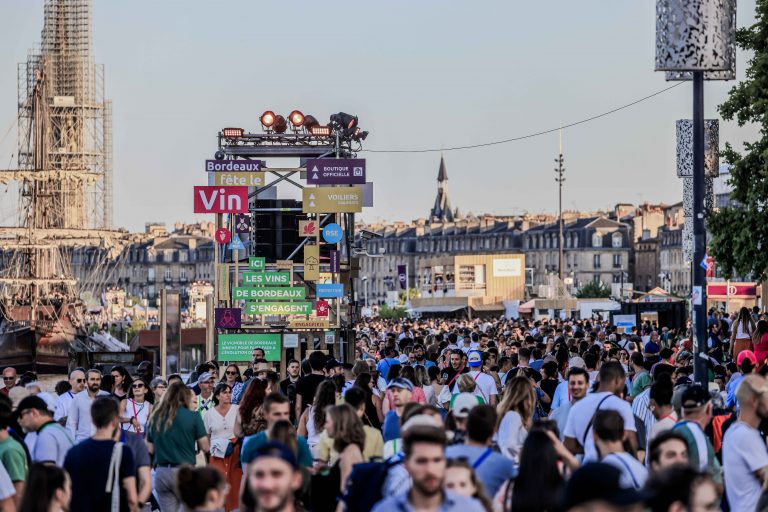
“What if the most beautiful object associated with Bordeaux wine was the bottle itself?” asked French writer, editor, and art historian Jacques Sargos. The Bordelaise has also won over the world of art. From June 28 to July 1, some thirty giant bottles designed by French and Chinese artists were displayed on the quays of Bordeaux during the Bordeaux Wine Festival. This exhibit, “Les Bordelaises XXL,” was also presented at Bordeaux’s Public Garden and in Hong Kong during the Wine and Dine Festival last November. The artist Joffo decorated the giant Millésima bottle. And fashion designer Jean-Charles de Castelbajac created a giant bottle dubbed “Fantôme de Bacchus.” “When you open a bottle that dates back to World War II, there’s something about opening such a container that takes you back to a legendary dimension.”
 
The Bordeaux bottle, with its sleek and elegant shape, contributes to the influence and reputation of Bordeaux wines around the world.

Newsletter

  • Staying up to date on all the latest Bordeaux news is easy.
    Become a member today and receive email updates on events
    coming your way.

  •  
     
     
  •