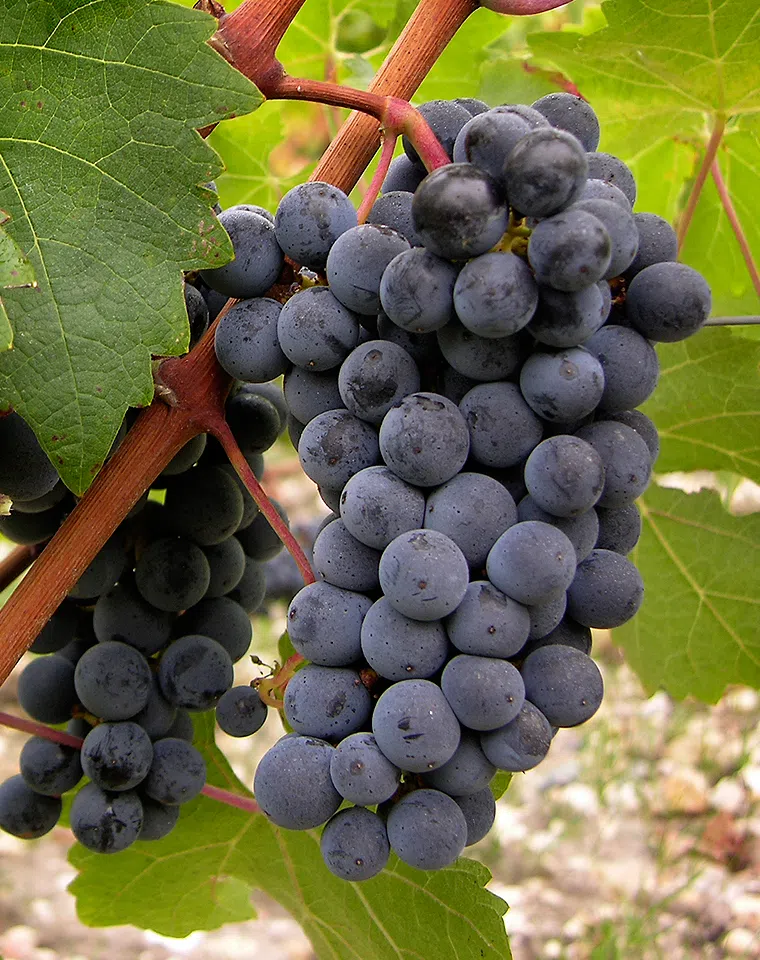
Carménère – colour turned up to full volume
An old Médoc variety that nearly vanished from Europe after the phylloxera crisis, Carménère has had quite the comeback. Long criticised for its irregular yields, it has found a new life in blends — and what a return: its remarkably deep colour is its unmistakable signature.
Sensory
profile
Early
Late
Sweet
Acidic
Light
Powerful
Who’s behind the skin of carménère ?
A true rarity in Bordeaux (barely 0.1% of red plantings), Carménère isn’t the easiest cépage to shepherd to full maturity. Early‑budding and naturally low‑vigour, it produces small clusters with medium‑sized berries that deliver intensely coloured wines. Its tannins show the same generosity, softening beautifully with time. And its personality? Fruity, spicy, with just the right touch of bitterness to spark curiosity.
And in the glass?
Sight
deeply coloured, with vivid violet highlights you simply can’t miss.
Nose
a fruit‑forward bouquet of strawberry, blackberry and raspberry, lifted by the cépage’s hallmark peppery and herbal notes.
Palate
supple, fleshy texture with expressive, forward tannins.
In blends
Carménère brings a vibrant boost of colour to Bordeaux’s more widely planted red varieties.

Good to know
- One of Bordeaux’s oldest cépages.
- The result of a natural crossing between Cabernet Franc and Gros Cabernet.
- Its name stems from carminium, Latin for the deep crimson shade that defines it.
- Known under many aliases: carmenelle, cabernelle, carbouet in the Graves, or bordo in Emilia‑Romagna, Italy.
- Its yields are notoriously uneven — a consequence of its sensitivity to coulure.

where doescarménère grow?
You’ll find it in small touches across Bordeaux, though it remains a secondary cépage in most AOPs. It thrives particularly well on sandy and sand‑gravel soils. One exception worth noting: Pomerol, where Carménère is entirely absent.
Other red grape varieties
Merlot, Cabernet sauvignon, Cabernet franc, Petit verdot, Malbec