Fronsac, bold by
nature
An undulating landscape, a long history, and red wines of great character and charm – it’s easy to see why people love Fronsac. And that’s before we get to the terroir, a natural treasure trove lovingly tended by Fronsac’s winegrowers, vintage after vintage.
What is the Fronsac wine region?
Key points to remember
- 800 hectares, 100 winegrowers and 7 villages: Fronsac, Saint-Aignan, La Rivière, Saint-Michel de Fronsac, Saint-Germain-la-Rivière, Saillans, and Galgon.
- A prime location on the outskirts of Libourne, thirty kilometers east of Bordeaux, with a limestone plateau and clay-limestone hillsides which make all the difference. All wrapped up in a unique microclimate formed as the Isle River flows into the Dordogne – ideal conditions for ripening grapes to perfection.
- A clear commitment to protecting nature, with agro-environmental measures integrated into the appellation’s specifications since 2011, and 85% of estates holding environmental certifications. In Fronsac, winegrowing and ecological intelligence go hand in hand.
Why do people love Fronsac and its wines?
- Because these are wines of great quality elevated by an inimitable sense of character, sprung from a truly extraordinary terroir
- Because each wine bears the mark of its maker, testifying to their finely-honed expertise and unfailing passion
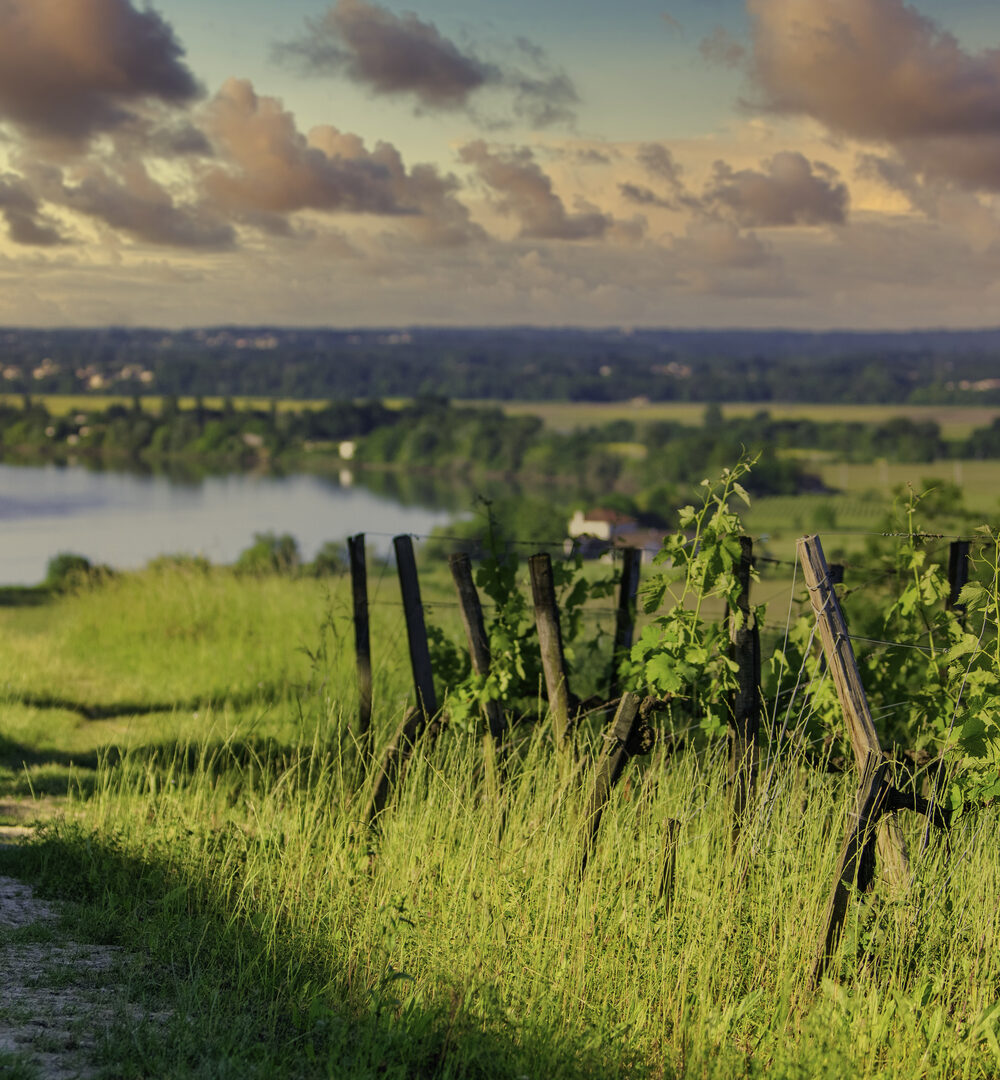
- Because of the sublime views, with rolling hillsides to rival Tuscany
- Because Fronsac winegrowers have a longstanding commitment to protecting the environment
- Because its estates, often family-owned, are heirs to a long and rich history.
- Because with its heritage, quaint villages and natural splendor, there are a thousand-and-one ways to explore Fronsac (including its châteaux and wine road, of course!)

What is the
Fronsac style?
Tasting Fronsac wines is all about power and pedigree. The kind of character everyone can agree on.
The intense, ruby-red color sets the scene.
Next up, prominent red berry aromas really leap out of the glass, feisty yet delicate. They rub shoulders with a host of dark berry aromas, accented with spicy notes and even the occasional hint of truffle or game. The palate is elegant and full-bodied, underpinned by a rich and refined tannic structure which is Fronsac’s calling card.
These are seriously age-worthy wines, which become more elegant and complex as the years go by.
Which kind of wines can be found in Fronsac?
Reds, and not just any old reds.
IVibrantly colored, generously proportioned, silky-smooth, ultra-aromatic Merlot accounts for 80% of the vineyards. Occupying around 15% of the area under vine, Cabernet Franc brings added elegance and a dash of spice, with firm tannins and a certain freshness. Last but not least, Cabernet Sauvignon enhances the wine’s rich, spicy character, while also extending its aging potential.
Fun facts
Three fun facts you need to know about Fronsac
Get up close and personal with this unique appellation.
1.
Fronsac shares a number of similarities with its little sister and neighbor Canon Fronsac. But since there is so much to say about this PDO, we have given it its own page.
2.
The great-nephew of the famous Duke of Richelieu decided that Fronsac was the ideal spot to build a “folly”, a country home of such extravagance that news of the wild parties held there reached the court of Louis XIV himself.
3.
Times change, and sometimes names change too: Fronsac used to be known as “Fronciacus”. We know this thanks to Eginhard, biographer of a certain Charlemagne, who mentions the village in his 8th-century chronicles.
Let’s talk about the soil
Fronsac is blessed with a real smorgasbord of soils, including asteriated limestone on the plateau, superb clay-limestone on the hillsides – the famous “Fronsac molasse” – and a few patches of siliceous clay at the foot of the slopes.
En voir plus
A geological patchwork of exceptional quality, aided and abetted by excellent drainage which ensures that there is never too much or too little water. The result? Incredibly rich and complex wines As for the grape varieties, Merlot thrives on cool clay-limestone, Cabernet Franc prefers the limestone and sand, and Cabernet Sauvignon is right at home on the warmest, driest soils.


Let’s travel back in time
As well as boasting breathtaking views over the Isle and the Dordogne Rivers, the Tertre de Fronsac (Fronsac mound) has shaped the history of the appellation.
En voir plus
This strategic stronghold was once home to a prominent Gaulish market, and later a Roman altar, and later still (sometime around 770) an impressive fortress built by Charlemagne.
As far back as the 8th century, Fronsac’s prime position on the pilgrimage trail to Santiago de Compostela contributed to the development of the region’s wines: the power of the Church was at its apogee, and monasteries took great care to produce fine wines. Throughout three centuries of English rule, the region’s wines became increasingly popular on the other side of the Channel.
The Duke of Richelieu snapped up the duchy of Fronsac in 1663, and his heirs propelled the wines to new heights of fame. The Libourne region was transformed once again in the 18th century: the quality and reputation of the wines soared, with international maritime trade cementing Fronsac’s place among Bordeaux’s most prestigious names. And that remains true to this day.