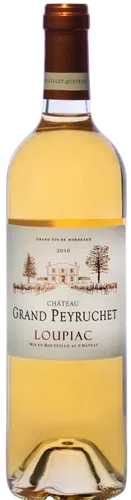
Loupiac,
a golden appellation
A mesmerizing golden color and elegant aromatic richness: Loupiac sweet white wines are impossible to resist. In this PDO, nature and winegrowers have clearly chosen quality over quantity. And this makes all the difference.
What is the Loupiac wine region?
Key points to remember
- 18 estates on a human scale, 300 hectares and a single commune: Loupiac, of course!
- Sunny vines on the Right Bank of the Garonne in the Premières Côtes de Bordeaux region, just half an hour from the city of Bordeaux. The humid climate during fall is propitious to the development of Botrytis cinerea (aka “noble rot”). This discreet yet precious fungus causes the grapes to over-ripen and their sugar and aromas to become concentrated – an essential prerequisite to naturally obtain fine sweet white wines.
- There, the so-called “late” harvest begins after the traditional harvest has ended to allow Botrytis cinerea to work its magic. It is carried out by hand in successive passes to ensure that only the grapes affected by noble rot are picked. In Loupiac, quality has to be earned!
Why do people love Loupiac and its wines?
- Because their sweetness and delicate aromas instantly delight the palate
- Because they go great with desserts, foie gras and various cheeses
- Because they are the perfect reflection of an authentic terroir, where winegrowing expertise is passed down from one generation to the next
- Because here, winegrowers are as inviting as their golden-colored wines, always open to sharing, tasting, and discussions
- Because we can’t get enough of the tasting days and other events that showcase the appellation all year round
- Because Loupiac offers much more than wine – the Saint-Pierre church and Gallo-Roman villa are also well worth a detour

What is the
Loupiac style?
From the very first sip, there is no doubt that Loupiac is the epitome of pure elegance, underpinned by wonderful aromatic complexity and cleverly balanced sweetness.
Like all fine Bordeaux sweet whites, these delicious wines instantly win over epicureans
Their golden color dazzles in the glass. Their bouquet transports tasters on an aromatic journey, where yellow flowers mingle with acacia, tropical fruit, fig, apricot, candied fruit, honey… not forgetting hints of gingerbread, currants and prunes.
They are rich and full-bodied on the palate, with a harmonious balance between unctuosity and finesse. Their sweetness is counterbalanced by good acidity, culminating in a long finish.
Time is clearly on the side of these fine and generous sweet white wines, which become increasingly powerful and elegant with age.
Which kind of wines can be found in Loupiac?
Sweet white wines, of course!
The king of the appellation, Sémillon has many assets, including its richness, roundness and an inimitably silky texture, not to mention its aromas of honey, candied fruit, dried apricots and white flowers. Its sidekick, Sauvignon Blanc, balances out the sweetness thanks to its lively acidity and herbaceous and citrus nuances. Muscadelle is more discreet, adding a touch of delicate complexity with floral and fragrant notes of orange blossom, rose and vanilla.

Fun facts
Three fun facts you need to know about Loupiac
Read on to discover (almost) everything there is to know about the secrets of this appellation.
1.
In 1832, the scholar and oenologist Jullien classified the first Loupiac wines on the same level as the Sauternes second growths. Proof that here, excellence is nothing new.
2.
The 19th-century Bordeaux bourgeois were very fond of the region, so much so that they decided to settle on the vineyard’s slopes, where they built extravagant estates known as “folies”.
3.
“Loupiac” used to be known as “Lupicius”, meaning “wolf” in Latin. This had nothing to do with winegrowing, even if nowadays the name is intrinsically linked to fine wines.
Let’s talk about the soil
The Loupiac hillsides are ideal for growing sweet white wines: a limestone subsoil with gravelly-clay slopes and a hilly topography which naturally drains rainwater.
The result? Grapes that can slowly turn golden under the sun’s rays while fully concentrating their aromas and sugar.
En voir plus


Let’s travel back in time
The Loupiac vineyard dates back to Antiquity, as can be seen in the impressive vestiges of its Gallo-Roman villa! But it wasn’t until the Middle Ages that it really took on another dimension: trade between Bordeaux and England really helped the reputation of these wines to take off!
En voir plus
In the 17th century, the Dutch also made their mark: they boosted local production and introduced breakthrough innovations, such as barrel and bottle aging thanks to the use of sulfur sticks.
After the phylloxera crisis, the region’s wines were replanted with noble grape varieties tailored to producing sweet white wines. The Loupiac PDO was created in 1936, within the limits established a few years earlier by the Bordeaux Court of Appeal. And the region has continued to make brilliant wines ever since!